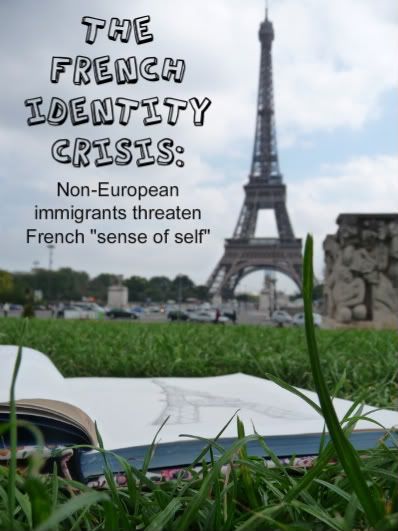
This post was going to be "Jacobin Republicanism vs. Cultural Pluralism."
The riots were actually fueled by the deaths of two boys on October 27, 2005. A witness named Siyakha Traoré recalls being intercepted on the street by a young boy named Muhittin Altun, a friend of his younger brother Bouna. Muhittin’s body was badly burned, his clothing was smoking, and young Muhittin was crying the names “Bouna… Zyad!” while pointing to the electric transformer a block away. Siyakha contacted the fire department and waited for them to come rescue his younger brother from the transformer. When the firemen found Bouna and Zyad, their bodies were so badly burned that Siyakha could not identify his own brother.
Bouna and Zyad climbed up into the electrical substation in an effort to escape the police. The boys had been walking home from a soccer match when the police spotted them and ordered the boys to provide identification. The boys had forgotten their papers at home, and they were afraid of what the police would do to them, so they fled. Bouna, Zyad, and Muhittin scaled the tall wall surrounding the substation and, once they were inside, the police determined that they could abandon their pursuit. As one police officer radioed to his commanding officer, “We need reinforcements to surround the neighborhood… On second thought, if they entered the EDF site, their skin is worth nothing now.” If the police had contacted the power company, the boys’ lives could have been spared. However, Sarkozy announced that the police had done nothing wrong, and that no investigation or indictment was necessary. Two days later friends, neighbors, and a thousand Parisians of every color gathered in the streets to mourn the deaths of the two boys. They held signs that said, “Dead for Nothing.” This was the beginning of a more poisonous relationship between the French police forces, Nicolas Sarkozy, and immigrant population.
26.2.10

19.2.10
Social, Cultural, and Economic Integration of Minorities
If the “modèle d’intégration républicaine” is no longer working to integrate immigrants, there are two options for France. First, France needs to recognize its diverse population and cater to the customs of all ethnicities equally. This would mean permitting Islamic women to wear burqas in public, approving the construction of Islamic minarets throughout the country, improving housing conditions for North African workers, allowing the immigrants political representation, and still meeting the needs of white French citizens. This system would require each ethnic group to compromise and be accommodating, but each group would also be able to maintain a sense of cultural identity. Otherwise, France needs to take a second look at the “modèle d’intégration républicaine” and format it to the twenty-first century. France would need ensure that all legal immigrants receive the same privileges as other French citizens. However, at the same time, France would have to ask immigrants to conform to French standards. In some cases, that might mean asking immigrants to adopt French customs while giving up some of their traditional practices (such as women not wearing burqas in Paris). The trade-off for giving up immigrant customs would be full acceptance into French culture. For this system to work, though, immigrants would need to be willing to accept the values of their new country, and French citizens and politicians would need to become blind to skin color.
12.2.10
5.2.10
Current Policies and Politics of Immigration into France
The conditions for French immigrants have not sufficiently improved in the last five years. France utilizes a “modèle d’intégration républicaine,” a model that dictates how to integrate immigrants into French citizenship. This system is intended to negate criteria such as ethnicity, race or religion; therefore, under this system, immigrants are guaranteed equal treatment, despite differences in nationality and faith. However, as demonstrated by the riots of 2005, the model of immigrant integration is a broken system. If the model were in effect in France, the police would not have senselessly beat dark-skinned protestors (Arab and African) to the ground, while frequently sparing protestors with white skin. Likewise, France would not be experiencing segregation and discrimination in three areas: at a personal level, which lowers self-esteem and fosters stereotypes; at an economic level, which limits employment opportunities and lowers social status; and at an institutional level, where immigrants are prevented from participating in policy-making.
Truthfully, the riots in France were not a conflict between different ethnicities, although ethnic conflict was an issue, because the riots were not designed to further the immigrants’ ethnic interests. Instead, segregation, which magnified cultural inequalities into violent discrimination, was the cause. After the 1968 riots in Washington D.C., United States Federal Communications Commissioner Nicholas Johnson stated, “A riot is somebody talking. A riot is a man crying out, “Listen to me mister. There’s something I’ve been trying to tell you and you are not listening.” More than an outburst by criminal “hoodlums,” as reported by Sarkozy, the riots were a plea for the French government to intervene on behalf of the immigrants and provide them with opportunities, equal to those of other French citizens, and a restoration of dignity. It was a plea for political representation on the behalf of poor working immigrants.
Truthfully, the riots in France were not a conflict between different ethnicities, although ethnic conflict was an issue, because the riots were not designed to further the immigrants’ ethnic interests. Instead, segregation, which magnified cultural inequalities into violent discrimination, was the cause. After the 1968 riots in Washington D.C., United States Federal Communications Commissioner Nicholas Johnson stated, “A riot is somebody talking. A riot is a man crying out, “Listen to me mister. There’s something I’ve been trying to tell you and you are not listening.” More than an outburst by criminal “hoodlums,” as reported by Sarkozy, the riots were a plea for the French government to intervene on behalf of the immigrants and provide them with opportunities, equal to those of other French citizens, and a restoration of dignity. It was a plea for political representation on the behalf of poor working immigrants.
Subscribe to:
Comments (Atom)