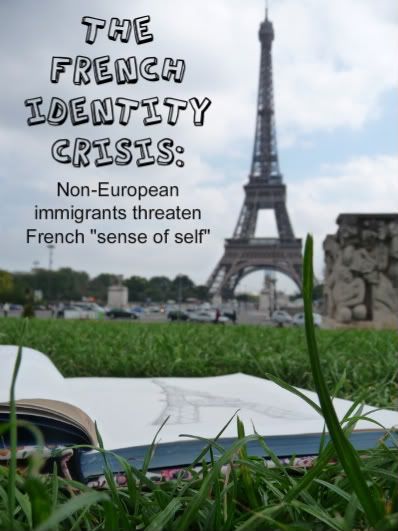
Riots are not an unusual occurrence in France; they generally last for two or three days, do minimal damage, and fade from the news after a week.[i] However, in October and November of 2005, France experienced a twenty-day riot that began in Clichy and spread through 200 towns in France. As the police in the banlieue used unwarranted violence on peaceful protestors, the intensity of the country-wide riots increased. During those two months of protest 10,000 cars went up in flames, 250 public buildings were destroyed, and insurance companies recorded 200 million euros in property damages.[ii]
It would have been tempting for white French citizens to link these riots to delinquency or depravity. After all, two factors were encouraging this mindset as the riots were taking place. The Interior Minister Nicolas Sarkozy (now the president of France) called the rioters hooligans, scum, and criminals who were “well known to the police.”[iii] Second, Sarkozy and other public figures maintained that the riots were spreading due to a “copy-cat effect” where minority youth were hearing about the riots in Clichy, either on the television or through rap music, and were attempting to imitate the rioting techniques they learned. A black French rapper named Monsieur R discounted the claim that rap caused the riots in France, and offered his observations:
“Just by the way they look at you they [police] give you the feeling that you are a second-class citizen, even if you were born here. Children are stopped for inspection five times, just on the way from their home to the metro! And I’m talking of a walking distance of less than 10 minutes. . . . Today in France the police logic is simple. . . . Here, if you’re black or Arab, it doesn’t matter if you have money or a good job, you’ll remain black or Arab your whole life.”[iv]
[i] Oberti, Marco. “The French reupublican model of integration: The theory of cohesion and the practice of exclusion.” New Directions for Youth Development 2008.119 (2008): 55-74. Academic Search Premier. EBSCO. Web. 30 Jan. 2010.
[ii] Jobard, Fabien. "Rioting as a Political Tool: the 2005 Riots in France." Howard Journal of Criminal Justice 48.3 (2009): 235-244. Academic Search Premier. EBSCO. Web. 20 Jan. 2010.
[iii] Ibid.
[iv] Schneider, Cathy Lisa. "Police Power and Race Riots in Paris." Politics & Society 36.1 (2008): 133-159. Academic Search Premier. EBSCO. Web. 26 Jan. 2010.