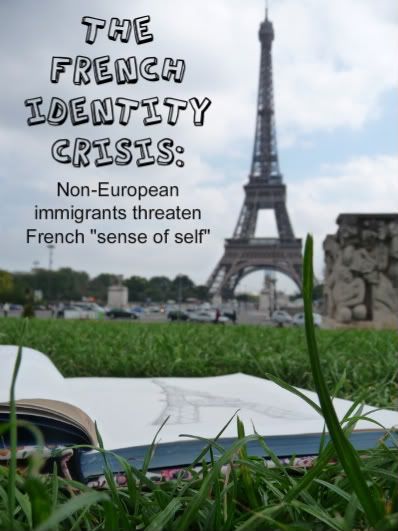
11.4.10

Dead for Nothing


My final project comes in multiple parts.

First, I wrote a rough draft of a paper, complete with source citations. It is not intended for submission; rather, it served as a location for storing my research as I worked on my project.

Then, I transformed those ideas into a short screenplay, complete with shot directions and dialogue. Due to the nature of the text, I did not cite any sources; however, all of the material I used came from my original paper, and you may find a full bibliography there.

Lastly, I made a brief (2:12) commercial concerning my topic. It is intended to make a complicated political issue more palatable for a general audience.

12.3.10

The French: Pride or Fear? What can France do?

It is clear that the “modèle d’intégration républicaine” would still not be a viable option, as Arab and African citizens of France are proud of their heritage. Therefore, the proposed first option would be the most successful attempt at integrating immigrants. If all habitants of France, white or colored, are willing to compromise, share, debate calmly, and submit to equal political representation, the immigrants will feel more included, and they will feel more welcomed. In 2005, immigrant families mourned the deaths of two colored boys who are “Dead for Nothing,” because neither the police nor the state cared about the lives of two immigrants. If France is going to overcome its current race war, the country will need to focus on addressing the needs, concerns, and hopes of all citizens; if the immigrants from Africa and the Middle East are recognized as more than “nothing,” they will have a great deal to contribute to France.

5.3.10

Switzerland and the Muslim Minaret Referendum


The Swiss minaret controversy began in a small municipality in the northern part of Switzerland in 2005. The contention involved the Turkish cultural association in Wangen bei Olten, which applied for a construction permit to erect a 6-metre-high minaret on the roof of its Islamic community centre. The project faced opposition from surrounding residents, who had formed a group to prevent the tower's erection. The Turkish association claimed that the building authorities improperly and arbitrarily delayed its building application. They also believed that the members of the local opposition group were motivated by religious bias. The Communal Building and Planning Commission rejected the association's application. The applicants appealed to the Building and Justice Department, which reverted the decision and remanded. As a consequence of that decision, local residents (who were members of the group mentioned) and the commune of Wangen brought the case before the Administrative Court of the Canton of Solothurn, but failed with their claims. On appeal the Federal Supreme Court affirmed the decision of the lower court. The 6-metre (20 ft)-high minaret was eventually erected in July 2009.

Many immigrants are crying "foul" against the minaret debate in Switzerland, and they are linking the debate to religious debate in France as well.

http://en.wikipedia.org/wiki/Minaret_controversy_in_Switzerland

26.2.10

Causes of the 2005 Riots

This post was going to be "Jacobin Republicanism vs. Cultural Pluralism."

The riots were actually fueled by the deaths of two boys on October 27, 2005. A witness named Siyakha Traoré recalls being intercepted on the street by a young boy named Muhittin Altun, a friend of his younger brother Bouna. Muhittin’s body was badly burned, his clothing was smoking, and young Muhittin was crying the names “Bouna… Zyad!” while pointing to the electric transformer a block away. Siyakha contacted the fire department and waited for them to come rescue his younger brother from the transformer. When the firemen found Bouna and Zyad, their bodies were so badly burned that Siyakha could not identify his own brother.

Bouna and Zyad climbed up into the electrical substation in an effort to escape the police. The boys had been walking home from a soccer match when the police spotted them and ordered the boys to provide identification. The boys had forgotten their papers at home, and they were afraid of what the police would do to them, so they fled. Bouna, Zyad, and Muhittin scaled the tall wall surrounding the substation and, once they were inside, the police determined that they could abandon their pursuit. As one police officer radioed to his commanding officer, “We need reinforcements to surround the neighborhood… On second thought, if they entered the EDF site, their skin is worth nothing now.” If the police had contacted the power company, the boys’ lives could have been spared. However, Sarkozy announced that the police had done nothing wrong, and that no investigation or indictment was necessary. Two days later friends, neighbors, and a thousand Parisians of every color gathered in the streets to mourn the deaths of the two boys. They held signs that said, “Dead for Nothing.” This was the beginning of a more poisonous relationship between the French police forces, Nicolas Sarkozy, and immigrant population.

19.2.10

Social, Cultural, and Economic Integration of Minorities

If the “modèle d’intégration républicaine” is no longer working to integrate immigrants, there are two options for France. First, France needs to recognize its diverse population and cater to the customs of all ethnicities equally. This would mean permitting Islamic women to wear burqas in public, approving the construction of Islamic minarets throughout the country, improving housing conditions for North African workers, allowing the immigrants political representation, and still meeting the needs of white French citizens. This system would require each ethnic group to compromise and be accommodating, but each group would also be able to maintain a sense of cultural identity. Otherwise, France needs to take a second look at the “modèle d’intégration républicaine” and format it to the twenty-first century. France would need ensure that all legal immigrants receive the same privileges as other French citizens. However, at the same time, France would have to ask immigrants to conform to French standards. In some cases, that might mean asking immigrants to adopt French customs while giving up some of their traditional practices (such as women not wearing burqas in Paris). The trade-off for giving up immigrant customs would be full acceptance into French culture. For this system to work, though, immigrants would need to be willing to accept the values of their new country, and French citizens and politicians would need to become blind to skin color.

5.2.10

Current Policies and Politics of Immigration into France

The conditions for French immigrants have not sufficiently improved in the last five years. France utilizes a “modèle d’intégration républicaine,” a model that dictates how to integrate immigrants into French citizenship. This system is intended to negate criteria such as ethnicity, race or religion; therefore, under this system, immigrants are guaranteed equal treatment, despite differences in nationality and faith. However, as demonstrated by the riots of 2005, the model of immigrant integration is a broken system. If the model were in effect in France, the police would not have senselessly beat dark-skinned protestors (Arab and African) to the ground, while frequently sparing protestors with white skin. Likewise, France would not be experiencing segregation and discrimination in three areas: at a personal level, which lowers self-esteem and fosters stereotypes; at an economic level, which limits employment opportunities and lowers social status; and at an institutional level, where immigrants are prevented from participating in policy-making.

Truthfully, the riots in France were not a conflict between different ethnicities, although ethnic conflict was an issue, because the riots were not designed to further the immigrants’ ethnic interests. Instead, segregation, which magnified cultural inequalities into violent discrimination, was the cause. After the 1968 riots in Washington D.C., United States Federal Communications Commissioner Nicholas Johnson stated, “A riot is somebody talking. A riot is a man crying out, “Listen to me mister. There’s something I’ve been trying to tell you and you are not listening.” More than an outburst by criminal “hoodlums,” as reported by Sarkozy, the riots were a plea for the French government to intervene on behalf of the immigrants and provide them with opportunities, equal to those of other French citizens, and a restoration of dignity. It was a plea for political representation on the behalf of poor working immigrants.